

Auckland Unitary Plan Update:PC79 and PC120
Plan Change 79 key outcomes
Council has confirmed and made operative a package of changes to the Auckland Unitary Plan transport provisions through Plan Change 79.The intent is to better support intensification while improving safety, accessibility and sustainable transport outcomes. In summary, PC79(their words):
Strengthens pedestrian safety and accessibility, with clearer thresholds and design requirements for pedestrian accessways, shared driveways, lighting and separation from vehicle movements.
Refines vehicle access and accessway standards, including clearer speed management, heavy vehicle access, and rear-site access requirements.
Updates accessible parking rules, confirming when and where accessible parks are required, with clearer exemptions and thresholds (particularly for residential developments).
Adjusts loading space requirements, narrowing when loading is required (e.g. focusing on arterial road access) and introducing small loading spaces where appropriate.
Improves cycling provision, with more flexible but clearer requirements for long‑stay bicycle parking in residential developments.
Requires better lighting outcomes for residential developments, particularly along pedestrian routes, to support safety and wayfinding.
Introduces EV readiness provisions, requiring new developments with car parking to be future‑proofed for electric vehicle charging, without mandating chargers themselves.
Tidies up and aligns provisions across E24 (Lighting), E27(Transport), E38 (Subdivision – Urban) and related definitions and appendices, reducing ambiguity and improving consistency.
Our comment:
PC 79:
Confirms most of the proposed plan change, but tinkered on the edges
Rear sites are in effect not developable unless car-free going forward
Consent will be required for the silliest things, such as a single step and a complying width path in six-plus lot schemes
Any required mobility spaces can be allocated to people without mobility issues?
3m access widths retained for emergency access purposes.
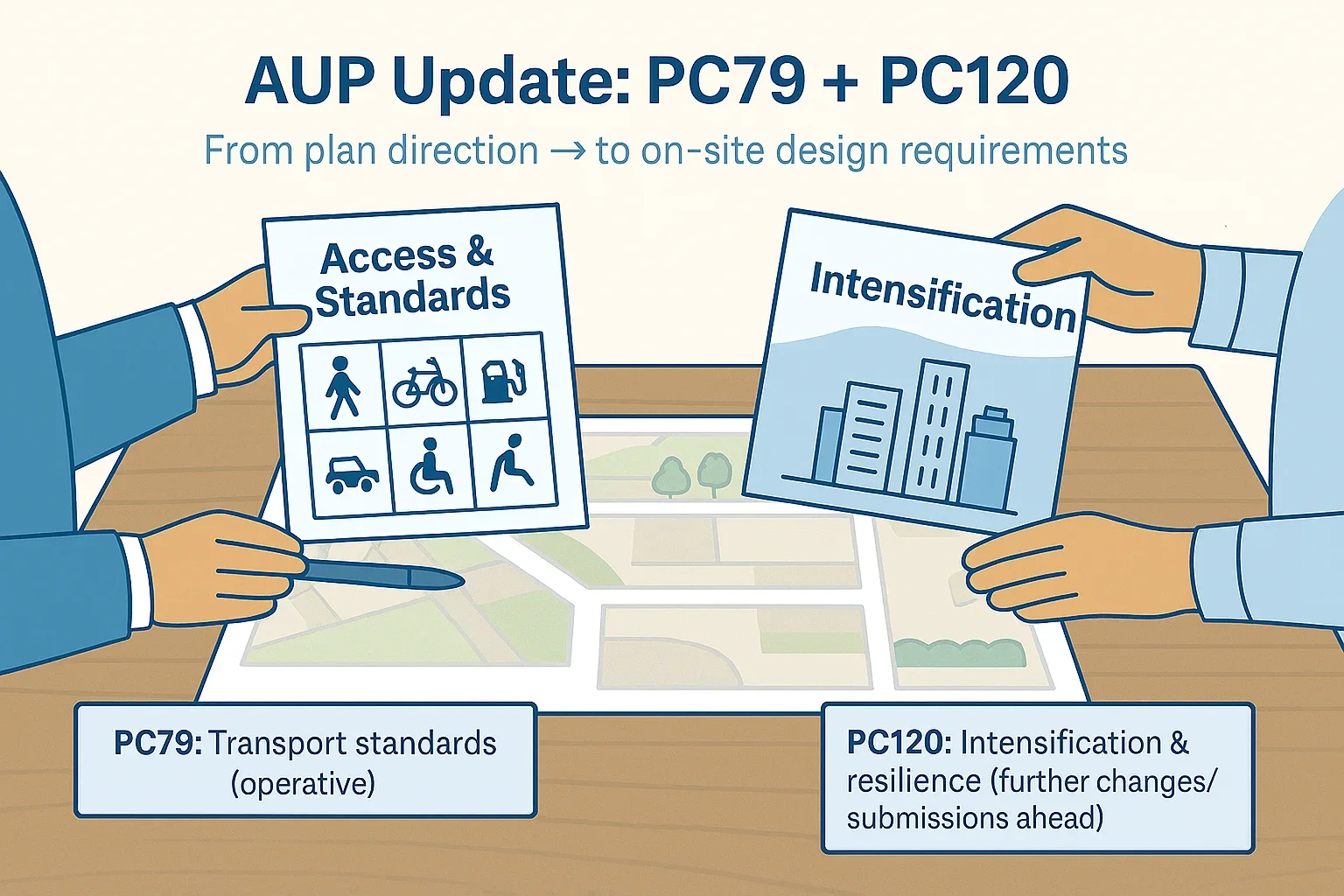
PC120 update: How Council intends to rebalance housing capacity
The council has agreed on 9 principles for updating PC120 to achieve the lower 1.6M plan-enabled capacity target, down from2M that it is currently trying to reach (this was also PC78 target, UP is 1.2M):
Retain downzoning for natural hazards, such as flooding and landslides, as already notified.
Retain mandatory intensification in walkable catchments and at Maungawhau/Mt Eden, Kingsland, Morningside, Mt Albert and Baldwin Ave railway stations.
Retain intensification that maximises investment in the City Rail Link.
Decrease housing capacity using a distance of more than 10kmfrom the city centre as a starting point.
Decrease housing capacity along corridors, starting with lower-ranked bus corridors.
Decrease the amount of MHU zoning in areas that lack good access to public transport or the city centre.
Retain qualifying matters (e.g., special character areas and volcanic view shafts).
Provide a buffer from the 1.6 million figure to give the independent hearings panel some flexibility when making recommendations to the council.
Investigate additional down-zoning for natural hazards.
Next steps:
Auckland sends its outline to Minister Bishop by 17 March
The government passes amendments to RMA by the end of April
New submission period
Carry on with the rest of the process – with a plan to be done by May 2027.
Our comment:
PC120:
The reduction of 2m- 1.6m is just an arbitrary number. It's not based on any actual, economically feasible testing. Council’s capacity modelling, in our opinion, is more accurate but still highly erroneous.
Reviewed submission will be lodged, encouraging council to pick wider areas where growth wants can occur
Watch every local area councillor lobby for less or no zoning upgrades in their patch.
The fear here is that PC120 will only be limited to walkable catchment areas and that the actual development growth generated will be much less than any model.